The Signal Nobody Wants to Ignore
There is a moment in financial history when two of the world’s greatest investors, operating on different continents and managing vastly different portfolios, simultaneously do the exact same thing: stop buying, start selling, and hoard cash at unprecedented levels.
That moment is May 2026.
Warren Buffett’s Berkshire Hathaway sits on a record $397.4 billion in cash. Meanwhile, Li Ka-shing’s CK Hutchison empire has been systematically selling off its crown jewel assets — UK power grids, telecom networks, and Panama Canal ports — building a war chest of approximately US$41 billion.
These two men have never coordinated their moves. Yet their strategies in 2026 are remarkably parallel. This is not a coincidence. It is a signal worth understanding.
Warren Buffett: $397.4 Billion and Waiting
The Cash Accumulation Story
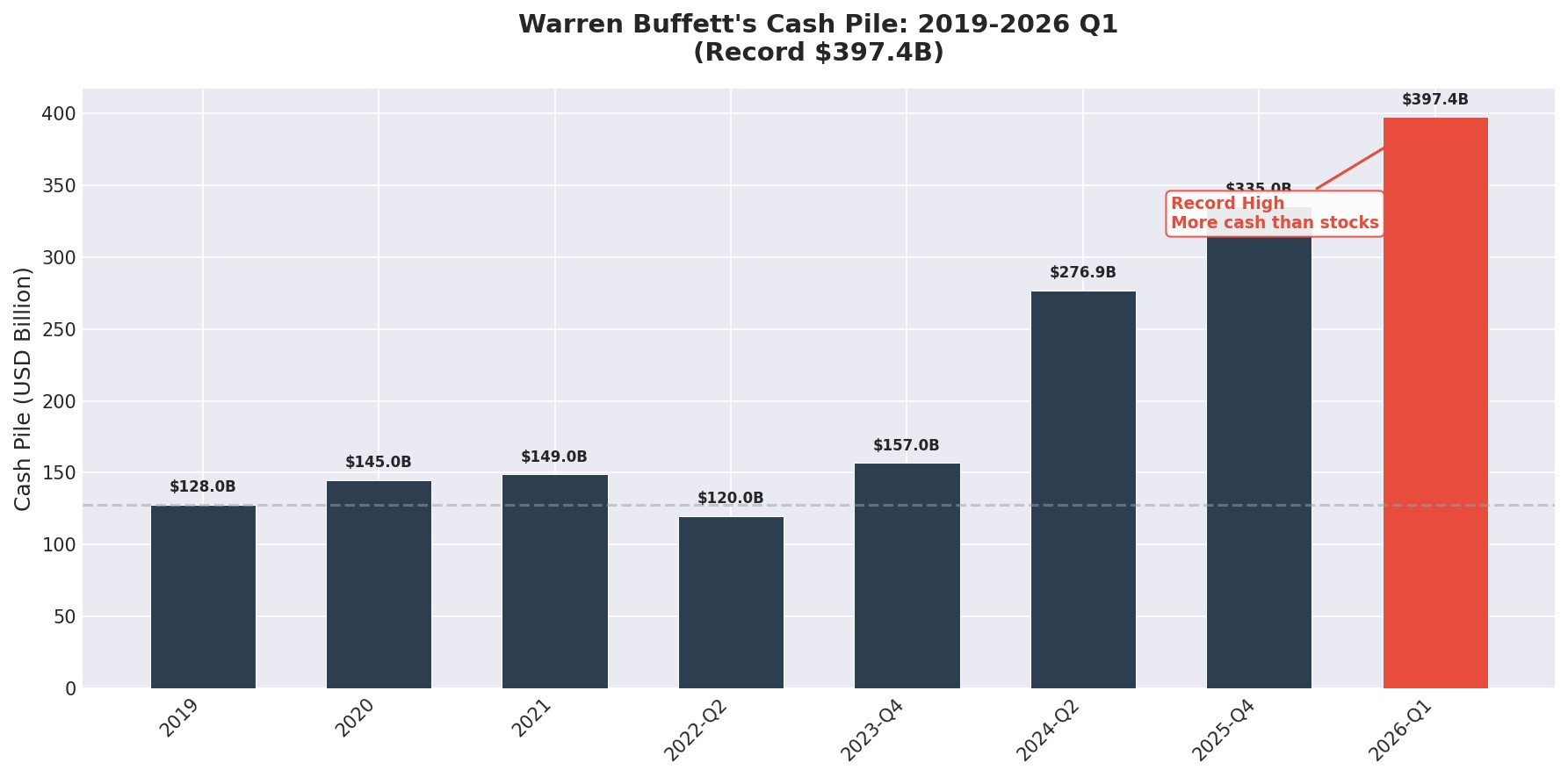
Buffett has been a net seller of stocks for more than three consecutive years. His cash pile has grown from $128 billion in 2019 to an astonishing $397.4 billion in Q1 2026 — a 210% increase in just seven years.
The most dramatic acceleration came in the last 18 months. Between Q2 2024 and Q1 2026, Berkshire’s cash grew by $120.5 billion — an average of $67 billion per quarter in net cash accumulation.
To put this in perspective: Berkshire’s cash pile is now larger than the GDP of South Africa, and represents approximately 59% of its total investable portfolio. Buffett holds more cash than stocks.
What Buffett Himself Says
In a March 2026 CNBC interview, the 95-year-old Buffett explained his philosophy: “Cash is necessary like oxygen, but it’s not a good asset.” He has stated that in his 60 years of investing, only about 5 years offered “really juicy” opportunities. The implication is clear: we are not in one of those 5 years right now.
The Dot-com and Financial Crisis Precedent
The last two times Buffett held record cash levels, major market crashes followed:
| Event | Cash Level | Market Crash | Timeline |
|---|---|---|---|
| 1999-2000 | Record at the time | Dot-com crash (March 2000) | ~12 months |
| 2007-2008 | Massive cash reserves | Financial crisis (Sept 2008) | ~12-18 months |
| 2022-2026 | $397.4B (current) | ? | ? |
The pattern suggests a 12-24 month window between peak cash accumulation and the next major market opportunity — or crisis.
Li Ka-shing: Selling the Crown Jewels
Recent Asset Sales Timeline
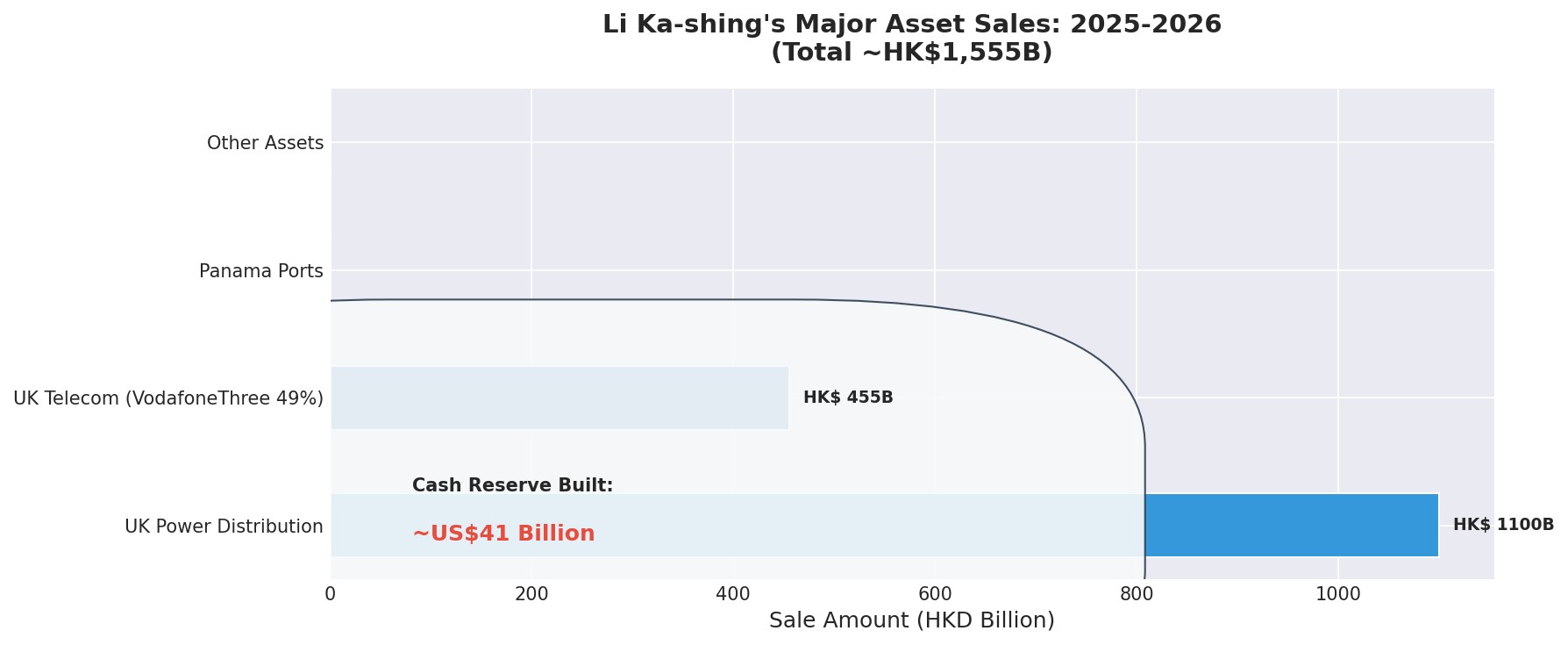
Li Ka-shing’s CK Hutchison has been executing one of the most significant asset restructuring programs in Asian business history:
| Date | Asset | Amount | Notes |
|---|---|---|---|
| May 2026 | UK Telecom (VodafoneThree 49%) | HK$455B | Latest major sale |
| February 2026 | UK Power Distribution (largest network) | £10.5B (~US$14.2B) | CK Infrastructure |
| 2025 | Panama Canal Ports | TBD | Geopolitical risk mitigation |
| Cumulative | Total cash-out | ~HK$1,555B | Ongoing |
Bloomberg reported in May 2026 that the CK Group is building a war chest of at least US$41 billion for the “next version of the conglomerate.”
Where Is the Money Going?
According to FT (March 2026), CK Hutchison is unlikely to return capital to shareholders. Instead, the cash is being redirected toward:
- Artificial Intelligence and technology investments
- Biopharmaceuticals and healthcare
- New energy and renewable infrastructure
- Asian markets (shifting focus away from Europe)
This represents a fundamental transformation from a traditional infrastructure and telecoms conglomerate into a technology-forward investment group.
The Parallel: What Two Legends See That Others Don’t
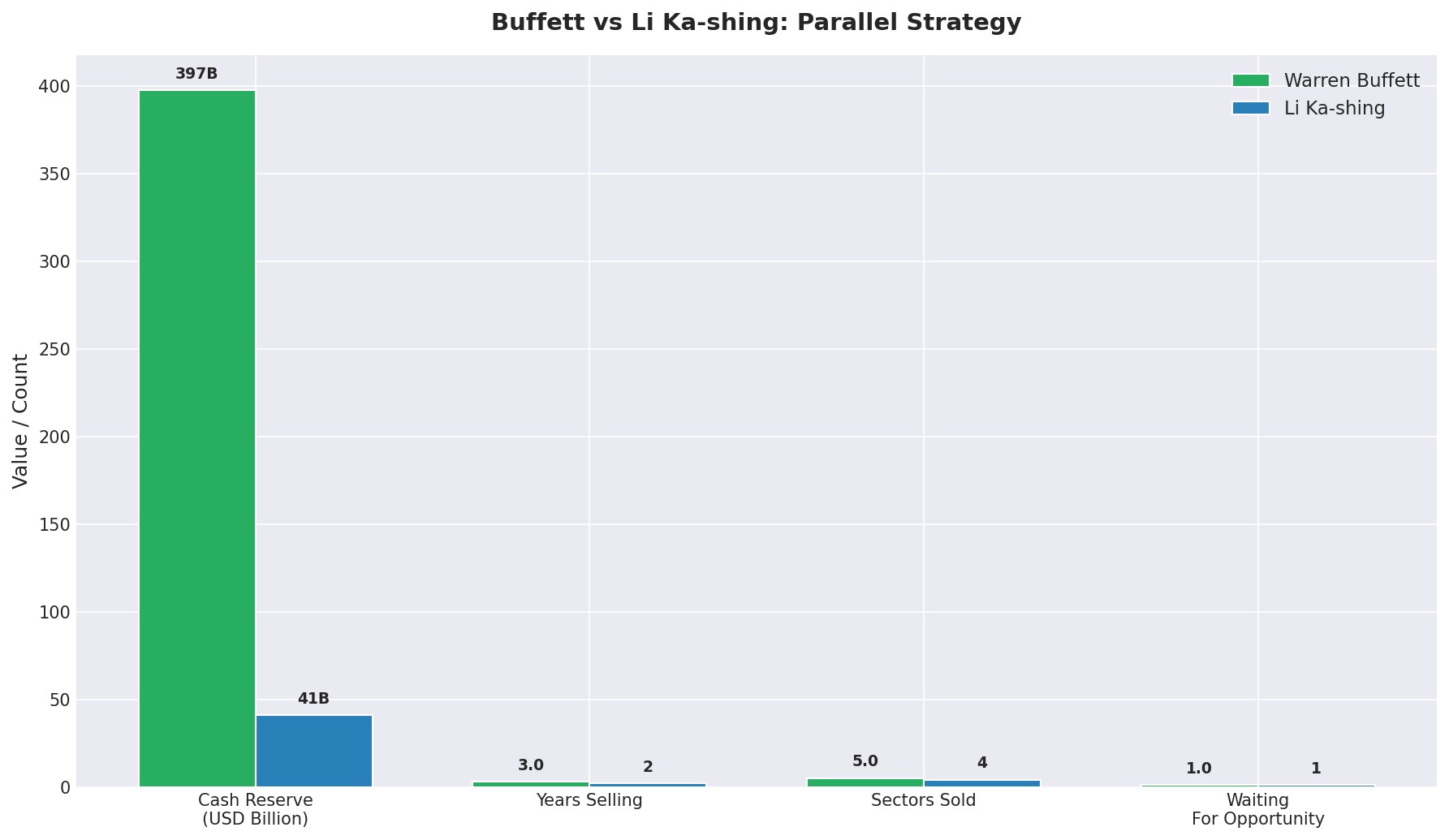
When two investors of this caliber — with different styles, geographies, and industries — arrive at the same conclusion independently, it deserves attention.
Shared Logic
1. Valuations Are Too High
The Shiller CAPE ratio (Cyclically Adjusted Price-to-Earnings) for the S&P 500 is hovering at levels not seen since the dot-com bubble. Buffett cannot find investments large enough to “move the needle” for Berkshire’s massive portfolio.
2. Geopolitical Risk Is Rising
Buffett is concerned about US market frothiness and the concentration of tech valuations. Li Ka-shing is hedging against European geopolitical risks and China-US tensions. Both are choosing geographical and asset diversification through cash.
3. Cash Is Ammunition
Both have explicitly stated their preference for owning companies over holding cash. The cash is not the goal — it is the means to act decisively when opportunities arise.
4. Generational Transition
Buffett (95) has handed control to Greg Abel. Li Ka-shing (97) has passed leadership to his son Victor Li. Both are positioning their empires for the next generation — and that means starting with clean balance sheets.
Historical Pattern: Should We Expect Another Crisis?
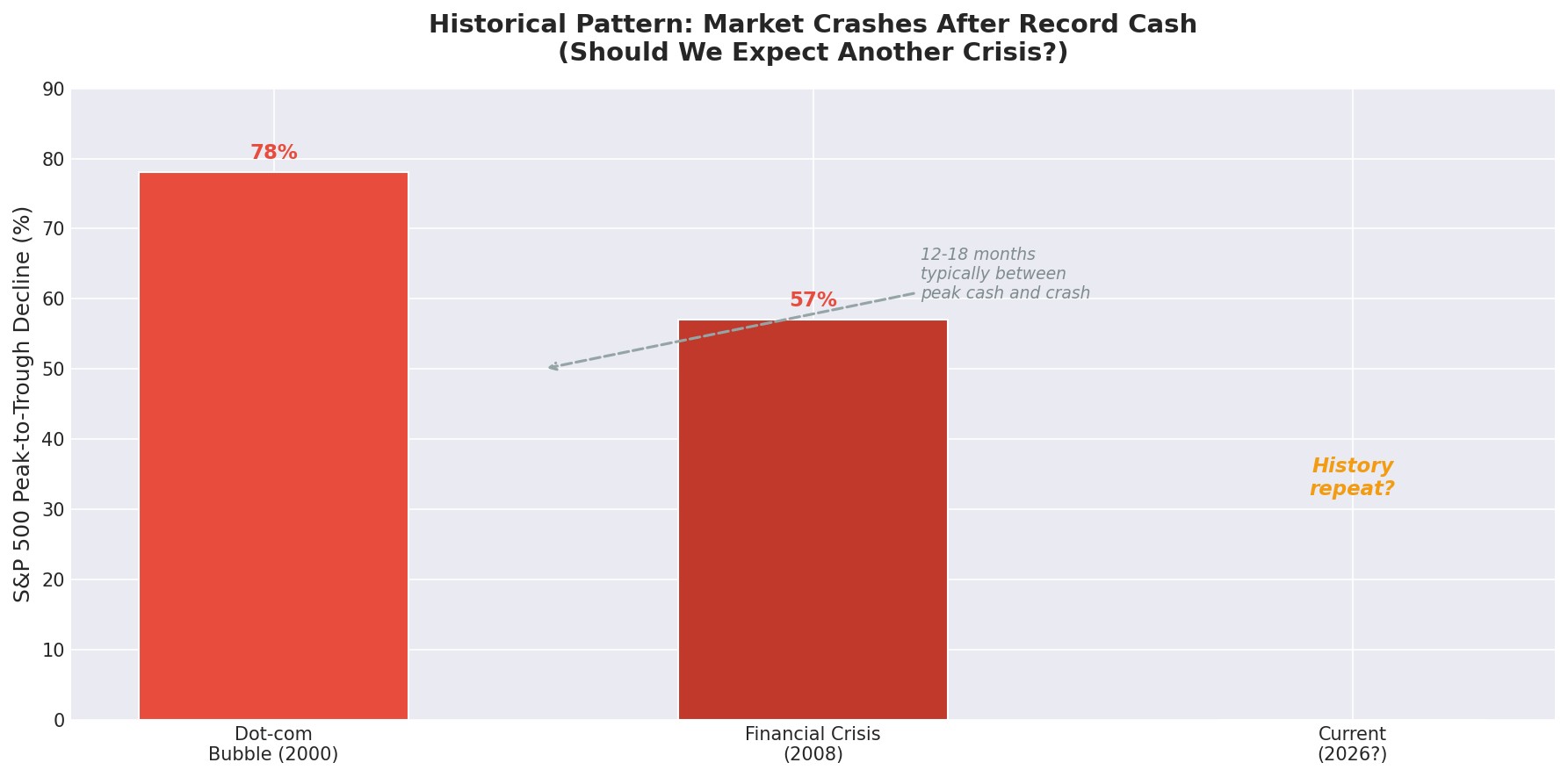
The data is compelling:
- Dot-com bubble (2000): S&P 500 fell approximately 78% from peak to trough
- Financial crisis (2008): S&P 500 fell approximately 57% from peak to trough
- Current situation (2026): Buffett’s cash is at an all-time high, and the Shiller CAPE is at dot-com-era levels
Economist Gary Shilling predicted in May 2026 that a recession is “almost inevitable” this year, with the S&P 500 potentially falling as much as 30% by year-end. Polymarket prediction markets currently price the probability of a US recession by end of 2026 at 23%.
Key Warning Signs in 2026
| Indicator | Current Value | Signal |
|---|---|---|
| S&P 500 Shiller CAPE | Dot-com era levels | Overvalued |
| US Consumer Confidence | 72% negative (Pew, Feb 2026) | Extremely pessimistic |
| Personal Savings Rate | 3.6% (lowest since 2022) | Fragile |
| Real Disposable Income Growth | 0.4% YoY (3-year low) | Weakening |
| Energy Prices | +12.5% YoY (Iran conflict impact) | Inflationary pressure |
What This Means for Investors
The “Buffett-Li Signal” Framework
When both Buffett and Li Ka-shing hold record cash simultaneously, history suggests the following timeline:
| Phase | Timeline | What Happens |
|---|---|---|
| Cash Accumulation | 2022-2026 | Both sell aggressively, build cash |
| Market Adjustment | Late 2026 - Mid 2027 | Potential correction (Shilling: -30%) |
| Opportunity Phase | 12-24 months post-crash | Both deploy cash at depressed valuations |
| Wealth Creation | 2028-2030 | New investments generate outsized returns |
Practical Takeaways
1. Cash Is Not Boring — It Is Strategic
Holding cash during overvalued markets is not cowardice. It is preparation. Both Buffett and Li demonstrate that the best investors are patient.
2. The Best Opportunities Come From Crisis
Buffett’s most famous investments — Goldman Sachs (2008), GE (2008) — came during moments of maximum fear. The cash pile is fuel for those moments.
3. Don’t Fight the Signal, But Don’t Panic Either
A potential correction does not mean selling everything. It means being selective, maintaining some dry powder, and being ready to act when others are forced to sell.
4. Diversification Matters More Than Ever
Li Ka-shing’s shift from Europe to Asia, from traditional to technology, shows the importance of strategic repositioning — not just defensive cash-holding.
The Bottom Line
Two of the greatest investors in history are sending the same message, through the same action, at the same time:
“We cannot find attractive investments at current prices. We will wait.”
Whether you agree with their assessment or not, the data behind their decisions deserves serious consideration. The combination of record cash levels, elevated valuations, geopolitical uncertainty, and weakening consumer fundamentals creates a risk environment that two legendary investors are treating with extreme caution.
As Buffett famously said: “Be fearful when others are greedy, and greedy when others are fearful.”
Right now, both he and Li Ka-shing are preparing to be greedy. The question is: when the opportunity comes, will you be ready?
What signals are you watching in today’s market?