In the world of management theory, there is a concept that is as quietly devastating as it is universally true. It was first introduced by Dr. Laurence J. Peter in 1969, and it has been sabotaging careers and companies ever since.
The Peter Principle states a simple but brutal rule: in a hierarchical organization, people are promoted based on their performance in their current role until they reach a level of incompetence.
In other words, if you are good at your job, you will be promoted. If you are good at the new job, you will be promoted again. This cycle continues until you land in a role you cannot perform well. At that point, you stop being promoted, but you also cannot go back. You remain stuck in a position where you are fundamentally out of your depth.
Over time, the logical consequence is that every position in an organization tends to be occupied by someone who is incompetent at performing it.
The Core Mechanism: The Mismatch of Skills
The fundamental crisis of the Peter Principle is that it uses past performance in one skill set as the primary indicator of future success in a completely different skill set.
Work can generally be divided into two types of skill sets as you move up a hierarchy:
| Skill Type | Examples | Role Focus |
|---|---|---|
| Technical / Hard Skills | Coding, financial analysis, surgical procedure, graphic design, operating heavy machinery | “Doing the work” — being an expert at the task |
| Managerial / Soft Skills | Budgeting, strategic planning, conflict resolution, motivating others, giving feedback, delegating | “Leading the people” — enabling others to do the work |
These are entirely different competencies. Excellence in one does not predict excellence in the other. Yet organizations continue to treat them as if they do.
The “Peter” Journey: Five Stages to Incompetence
An employee — let us call him Peter — is a spectacular salesperson. His technical skill is outstanding.
Stage 1: Competence
Peter shatters sales targets every year. The company sees this and wants to reward him.
Stage 2: The Promotion
He is promoted to Sales Manager. The reward for his past competence is the removal from his area of competence.
Stage 3: The Trap
Peter is now responsible for hiring, coaching, and managing the budgets of ten salespeople. He has zero training or natural talent in leadership.
Stage 4: Incompetence
His team fails because he continues trying to do their sales for them rather than mentoring them. He is overwhelmed by administrative work. He is stressed, and his team is unhappy.
Stage 5: Final Placement
Because his performance as a manager is bad, he stops receiving promotions. He remains in this managerial role, failing daily, until he quits, is fired, or retires. He has reached his level of incompetence.
A Story of Losing Your Stage
Let me tell you about Shuyu.
Shuyu was a brilliant software engineer. His world was made of clean code and elegant architecture. Whenever he sat in front of his monitor, he could untangle the most complex technical problems with a kind of quiet grace. His performance reviews were consistently outstanding, and the company promoted him to senior engineer. He thrived. His teammates admired his ability to solve problems that seemed impossible.
The executives saw his brilliance and decided to give him the greatest reward they could imagine: they promoted him to Engineering Manager.
That was the beginning of the end.
The new role no longer required him to write code. It required him to manage people, mediate conflicts, allocate budgets, sit through endless meetings, and navigate office politics. Shuyu had no training in any of these things, and worse, no natural aptitude for them.
The man who once shone brightest in the room became exhausted, anxious, and increasingly ineffective at leading his team. He missed the quiet satisfaction of solving a difficult algorithm. He missed the clarity of a compiler error. Instead, he faced the murky, emotional terrain of human dynamics, and he was drowning.
Shuyu could not be promoted further. But he also could not return to the world of code that once made him shine. He was stuck at a level he could not handle.
This is the Peter Principle in its most human form: people are rewarded for what they are good at, until the reward becomes the very thing that makes them fail.
Reading the Image: What the Infographic Tells Us
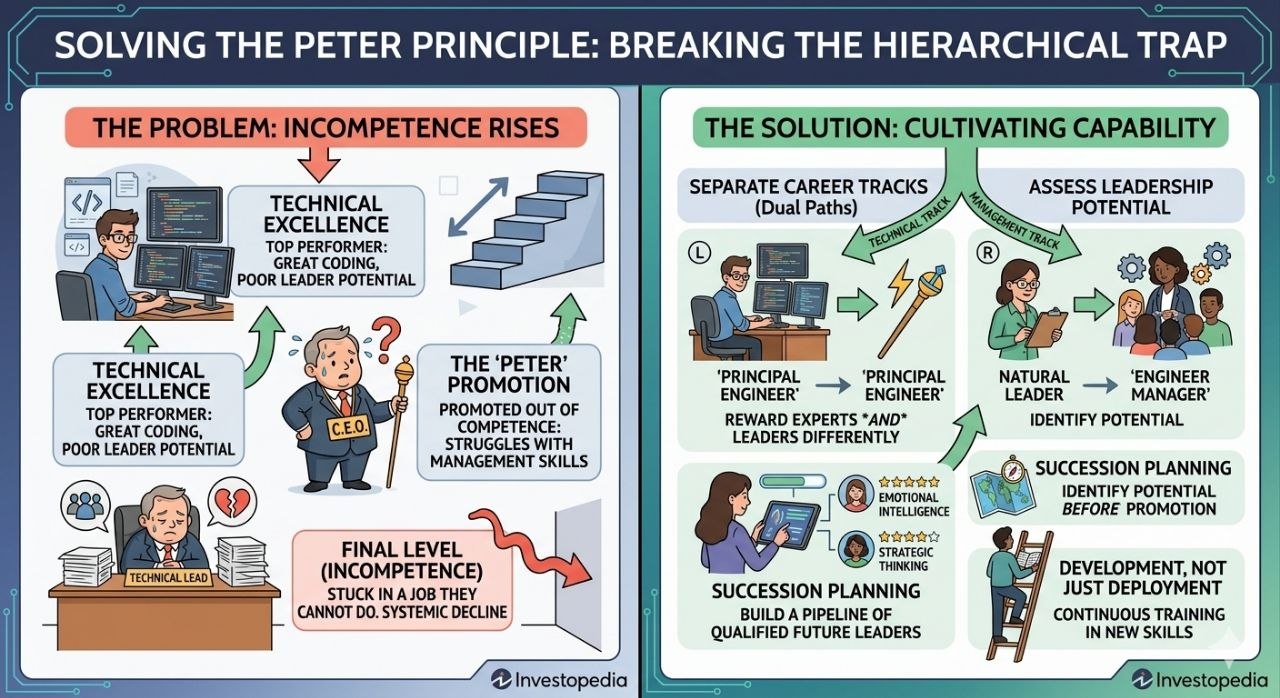
The infographic from Investopedia, titled “Solving the Peter Principle: Breaking the Hierarchical Trap,” uses dark humor and extreme contrasts to visualize this journey very effectively. It is split into two panels: the left showing the problem, and the right showing the solution.
The Left Panel: “Incompetence Rises”
The left panel shows a four-stage progression that maps directly onto the five-stage journey described above:
- Technical Excellence — A young developer at dual monitors, coding with focus. He is a top performer with great technical skill but poor leader potential.
- Technical Excellence (repeated) — Same capability, still excelling at the task.
- The “Peter” Promotion — The employee is promoted into a management role he is not qualified for. The infographic depicts this as a confused figure in an oversized CEO suit, holding a question-mark staff, with a nameplate reading “C.E.O.” and a desk sign reading “Technical Lead.”
- Final Level (Incompetence) — An exhausted, older man sits at a cluttered desk with a broken heart icon beside him. The label reads: “Stuck in a job they cannot do: systemic decline.”
The visual metaphors are powerful:
| Visual Element | Deeper Meaning |
|---|---|
| The oversized CEO suit | The traditional symbol of professional power that does not fit — the employee is literally dragging behind them the symbols of leadership they cannot control |
| The question mark | Self-awareness of incompetence — the employee knows they are failing and does not understand the job |
| Sweat drops | The physical manifestation of anxiety and stress caused by being in a role you are not qualified for |
| Broken heart icon | The human toll — both organizational decline and personal suffering |
| The baby (in some versions) | Professional immaturity for the new role — despite years of experience, the skill gap in leadership makes them as qualified as a child |
The Right Panel: “Cultivating Capability”
The right panel presents four interconnected solution strategies, each illustrated with its own visual metaphor:
Separate Career Tracks (Dual Paths) — A Y-shaped path splits into two directions: a Technical Track and a Management Track. A “Principal Engineer” can keep advancing technically without ever being forced to manage people. The message: reward experts and leaders differently.
Assess Leadership Potential — A woman with a clipboard evaluates a team. Before promoting someone, organizations should measure emotional intelligence, strategic thinking, and other leadership indicators — not just past technical performance.
Succession Planning — Building a pipeline of qualified future leaders. This means identifying potential before promotion and investing in continuous training in new skills.
Development, Not Just Deployment — A person climbs a ladder with a map and guidebook, representing a planned development journey rather than being thrown into a role unprepared.
The Consequences for a Company
When the Peter Principle plays out repeatedly across an organization, the entire business degrades:
Organizational Stagnation — The company loses its most innovative “doers” (the engineers, the salespeople) and gains a layer of ineffective managers. Progress slows.
Moral Drain — Skilled employees leave because they are managed by incompetent leaders who cannot help them grow.
Toxic Culture — Incompetent managers often try to hide their failures by becoming overly political, taking credit for others’ work, or micromanaging.
Financial Loss — Ineffective decision-making at the top, high employee turnover, and the loss of production from key technical experts.
How Companies Can Fight the Peter Principle
Modern businesses know about the Peter Principle and actively try to avoid it. They use three main strategies:
1. Separate Career Tracks (Dual Tracks)
Companies create two distinct advancement paths. A brilliant engineer can keep being promoted — receiving raises, better titles — along a “Technical Fellow” track, where they are rewarded for deep technical expertise without ever being forced to manage people.
A principal engineer should be paid and respected as much as a director. This removes the pressure to “climb the ladder” into roles that do not fit.
2. Performance vs. Potential Assessment
When considering someone for a promotion to management, companies now look beyond their current performance. They use assessments to measure leadership potential — emotional intelligence, strategic thinking — before making the decision.
3. The “Up-or-Out” Policy Is Wrong
Dr. Peter’s logic suggests that not everyone should be promoted. A good manager recognizes that some employees are perfectly placed and exceptionally competent in their current roles, and they should be rewarded there rather than removed.
Succession planning, continuous training, and development-focused growth ensure that when someone does move into leadership, they are actually prepared for it.
The Final Thought
The Peter Principle is not about failure. It is about misplaced excellence. It reminds us that the qualities that make someone exceptional in one role are not the same qualities that make them exceptional in another.
Shuyu was not a failure. He was a brilliant engineer placed in the wrong arena. And somewhere in your organization, there is someone just like him — someone who was promoted past their point of brilliance, left to struggle in a role that was never meant for them, while the world wonders why they stopped shining.
The question is not whether the Peter Principle exists in your company. The question is what you are going to do about it.
Who in your organization was promoted past their point of brilliance?