Most people and organizations communicate in exactly the same way: from the outside in. They start with what they do, explain how they do it, and maybe — maybe — mention why it matters as an afterthought.
Apple does the exact opposite. And that difference is worth billions.
The Golden Circle
Simon Sinek discovered something remarkable. The world’s greatest leaders and brands — from Apple to Martin Luther King Jr. to the Wright Brothers — all think, act, and communicate in the same direction: from the inside out.
He called it the Golden Circle. Three concentric rings:
The outermost ring is What — what you do, what product you make, what service you offer. Every organization knows this.
The middle ring is How — how you do it differently, what makes you better, your unique process or approach. Many organizations claim to have this.
The innermost ring is Why — why you exist, what you believe, what drives you beyond making money. Almost no organization can articulate this clearly.
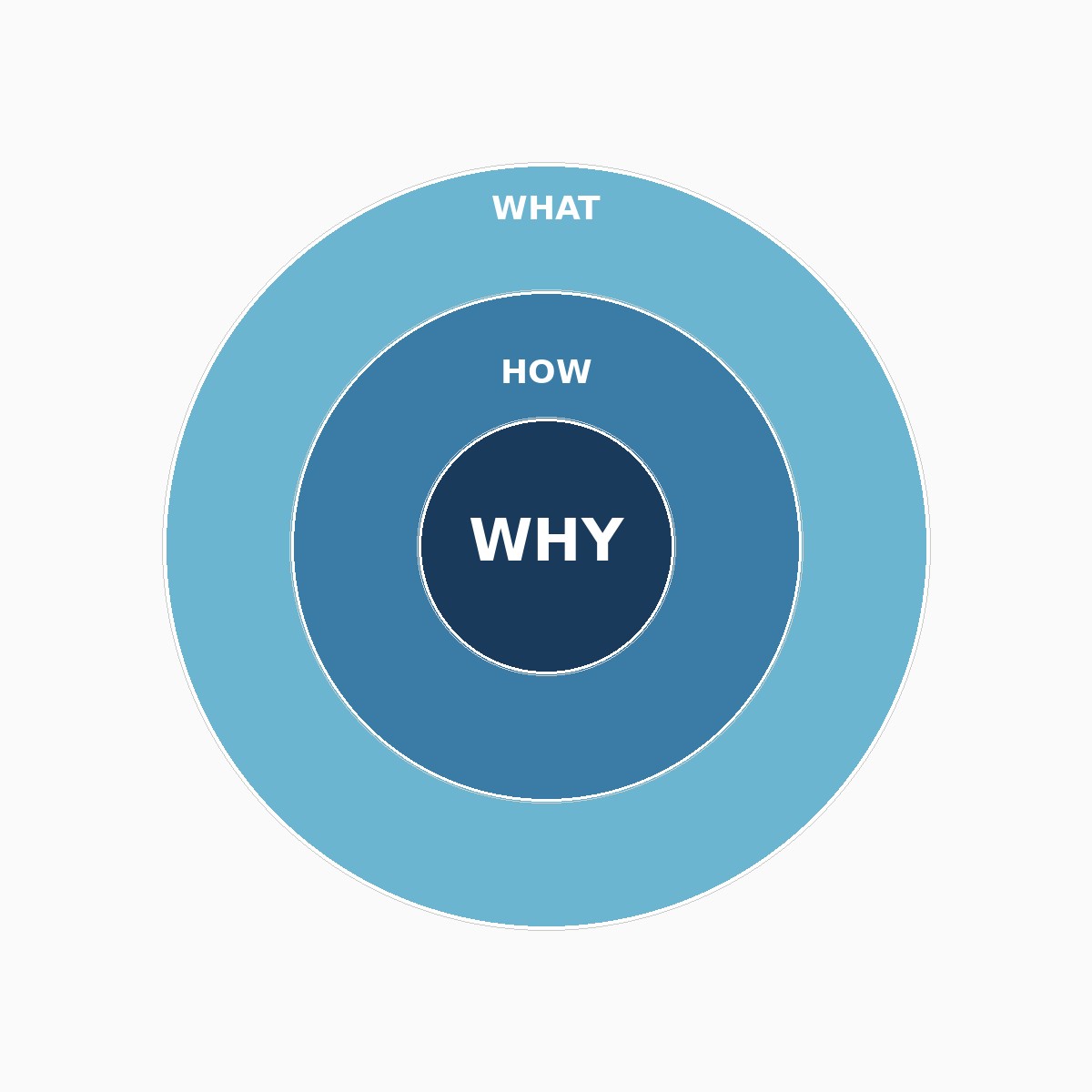
Almost no one starts here. That is exactly why almost no one stands out.
The Apple Example
If you ask most computer companies to describe themselves, they will say something like:
“We make great computers. They are beautifully designed, simple to use, and user-friendly. Want to buy one?”
That is outside-in communication. What → How → (nothing). It is accurate. It is boring. It is forgettable.
Apple communicates from the inside out:
Everything we do, we believe in challenging the status quo. We believe in thinking differently.
The way we challenge the status quo is by making our products beautifully designed, simple to use, and user-friendly.
We just happen to make great computers. Want to buy one?
Notice what changed. The words are almost identical. But the order is completely reversed. And that reversal changes everything.
Apple never said “we make the best computers.” They said Think Different.
People don’t buy what you do; they buy why you do it.
The Biology Behind It
This is not just clever marketing. It is biology.
If you look at the human brain from the outside in, the neocortex — which handles rational, analytical thought and language — corresponds perfectly with the What level. The middle two sections of the brain — the limbic brain, which handles all feelings like trust and loyalty, and all human behavior and decision-making, but has no capacity for language — correspond exactly with the How and Why levels.
When you communicate from the outside in, people understand the vast quantities of data and facts and figures you share. But it does not drive behavior. It does not create loyalty.
When you communicate from the inside out, you are speaking directly to the part of the brain that controls decision-making. And then the rational brain simply finds a way to justify the emotional decision that was already made.
This is why you can give someone every logical reason to do something — every fact, every figure, every data point — and they still will not do it. Because you have not reached the part of the brain that decides.
Beyond Business: Martin Luther King and the Wright Brothers
The Golden Circle is not limited to business. It explains almost every case of outsized influence in human history.
In August 1963, a quarter of a million people showed up on the National Mall in Washington, D.C. to hear Martin Luther King Jr. speak. None of them received an invitation in the mail. They came because they believed what he believed. King did not say “I have a plan.” He said “I have a dream.” He started with Why.
The Wright Brothers had no funding, no formal education, no press coverage, and no advantage over their chief competitor, Samuel Pierpont Langley — who had funding from the War Department, a team of the best minds available, and significant press attention. Langley was motivated by the prospect of riches and fame. The Wright Brothers were driven by a belief, a cause, a purpose. They flew on December 17, 1903. Langley quit days later.
The one who started with Why beat the one who had every other advantage.
Applying the Golden Circle to Your Work
This is not an abstract idea. It has immediate, practical application in how you lead, decide, and communicate every single day.
Before Making a Decision
Instead of asking “What should we do?” start by asking “Why are we doing this at all?” If the answer is unclear, no amount of execution excellence will save you.
When Communicating with Your Team
Instead of starting with the task list, start with the belief: “We are doing this because we believe that every product reaching the customer should be reliable. Here is how this task serves that belief.”
When Defining Your Direction
Companies that grow from good to great do not do it by being more efficient at what they already do. They do it by reconnecting with why they started in the first place.
The Friday Reflection
As you close your week, try this simple exercise. Take any decision you are facing — a project, a conversation, a plan — and map it against the Golden Circle:
| Ring | Question | Your Answer |
|---|---|---|
| Why | Why does this matter? What do I believe? | |
| How | How will I approach it differently? | |
| What | What specific action will I take? |
If you cannot fill in the Why row, stop. Do not proceed until you can.
Start with Why. Whether you are making a decision, setting a direction, or communicating with your team — begin from the core, move from the inside out, and the force you create will be entirely different.
What is your Why?