There is a viral infographic that circulates among academics every few months. It is called the “Pyramid of Academic Writing Time,” and it is simultaneously hilarious and devastating.
The image shows a pyramid divided into horizontal layers, each representing how much focused writing time a person manages in a typical week. At the bottom — the widest, most crowded layer — are the people who get zero minutes. They sit in darkness, buried under an avalanche of emails, meetings, teaching responsibilities, and administrative tasks. A little character in this layer is surrounded by floating paper icons and a notification badge that says “41 unread.”
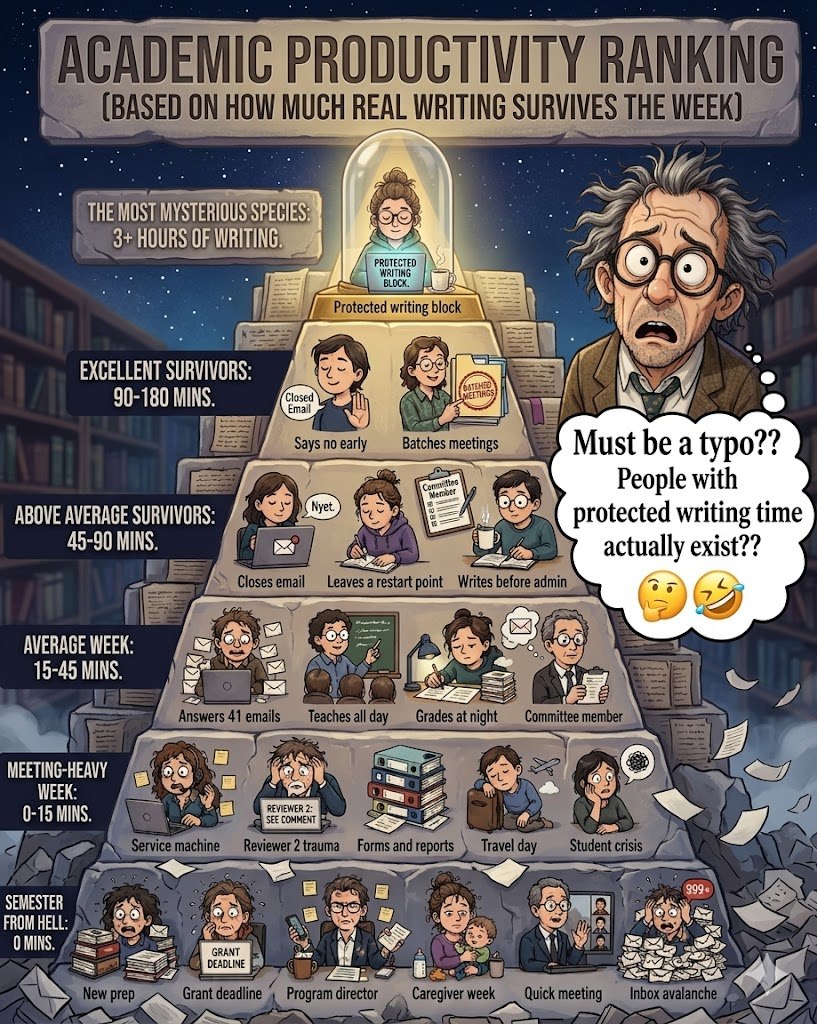
The Abyss — Zero Minutes
The bottom of the pyramid is where most people live. Zero minutes of writing. Not because they do not want to write. Not because they are lazy. But because the architecture of their week leaves no room for the kind of sustained, uninterrupted focus that real thinking requires.
These are the characters who:
- Start their day with “Just checking email quickly” and surface three hours later
- Have back-to-back meetings from 9 to 5
- Grade papers at night
- Answer “urgent” requests on weekends
- Have not opened their dissertation, manuscript, or quality report in three weeks
The pyramid’s dark joke is that this layer is the widest. It contains the most people. And they are not failing — they are functioning exactly as the system was designed: consumed by the operational, starved of the strategic.
The Abyss — What It Looks Like in Manufacturing
This is not just an academic problem. In quality management, the same pyramid applies:
| Academic Version | Manufacturing Equivalent |
|---|---|
| “41 unread emails” | “87 unread quality alerts in the system” |
| “Back-to-back teaching” | “Back-to-back production line fire-fighting” |
| “Grading papers at night” | “Writing NCR reports after hours” |
| “Haven’t opened dissertation in 3 weeks” | “Haven’t updated the quality manual in 3 months” |
The mechanism is identical: the urgent displaces the important.
The Middle — Resistance in the Cracks
Climb one tier up. 15-45 minutes. Not much, but something.
The characters here are still harried. They answer 41 emails. They teach all day. They grade at night. They sit on committees. But there is a faint glimmer of agency.
Another tier up: 45-90 minutes. Now we see tactics.
- “Closes email” — shutting off the source of noise.
- “Writes before admin” — giving the morning’s clearest mind to the highest-value work.
- “Leaves a restart point” — the bookmark symbol above a character’s head. A gentle thread left behind so the next restart costs nothing.
These are the small rebellions against chaos. In quality management terms, this is like closing Slack before a PPAP review, or leaving a clean comment when you are interrupted mid-way through complex data processing logic. It is the transition from being beaten by time to quietly steering it.
The Peak — The Most Mysterious Species
At the summit: “3+ Hours of Writing.”
A figure sits peacefully inside a glass dome labeled “Protected Writing Block.” A cup of tea steams nearby. A “Do Not Disturb” sign glows. The background sparkles with the soft light of deep focus.
This is a fortress of time. Whether you are architecting an ISO quality management system for the long term, or designing a high-level AI agent workflow, this undisturbed purity is non-negotiable. It is not just time management — it is the gentle defense of professional value.
Where Do You Stand?
This pyramid, wrapped in dark humor, is brutally honest. The question it leaves on the table is simple:
Which tier are you on today?
And more importantly — what is one small thing you could do this week to climb just one step higher?
Maybe it is batching meetings. Maybe it is a 90-minute “do not disturb” block. Maybe it is simply closing email for the first hour of the day.
The pyramid does not judge. It just shows the truth. And sometimes, seeing the truth is the first step toward changing it.
What would it take for you to reach the top tier?