🎬 Video Presentation
🇬🇧 English Version
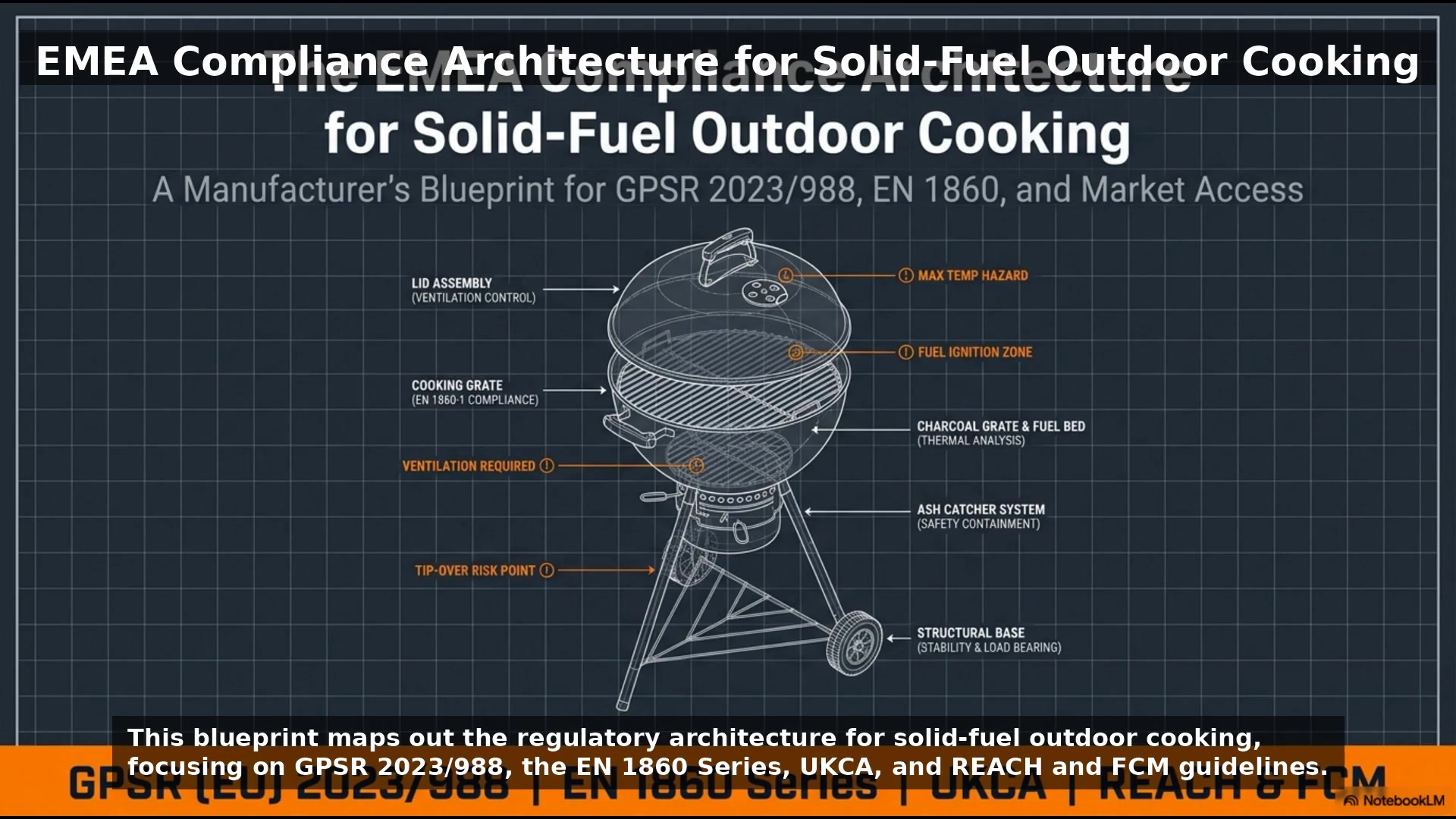
English Version — EMEA Compliance Blueprint
🇨🇳 中文版
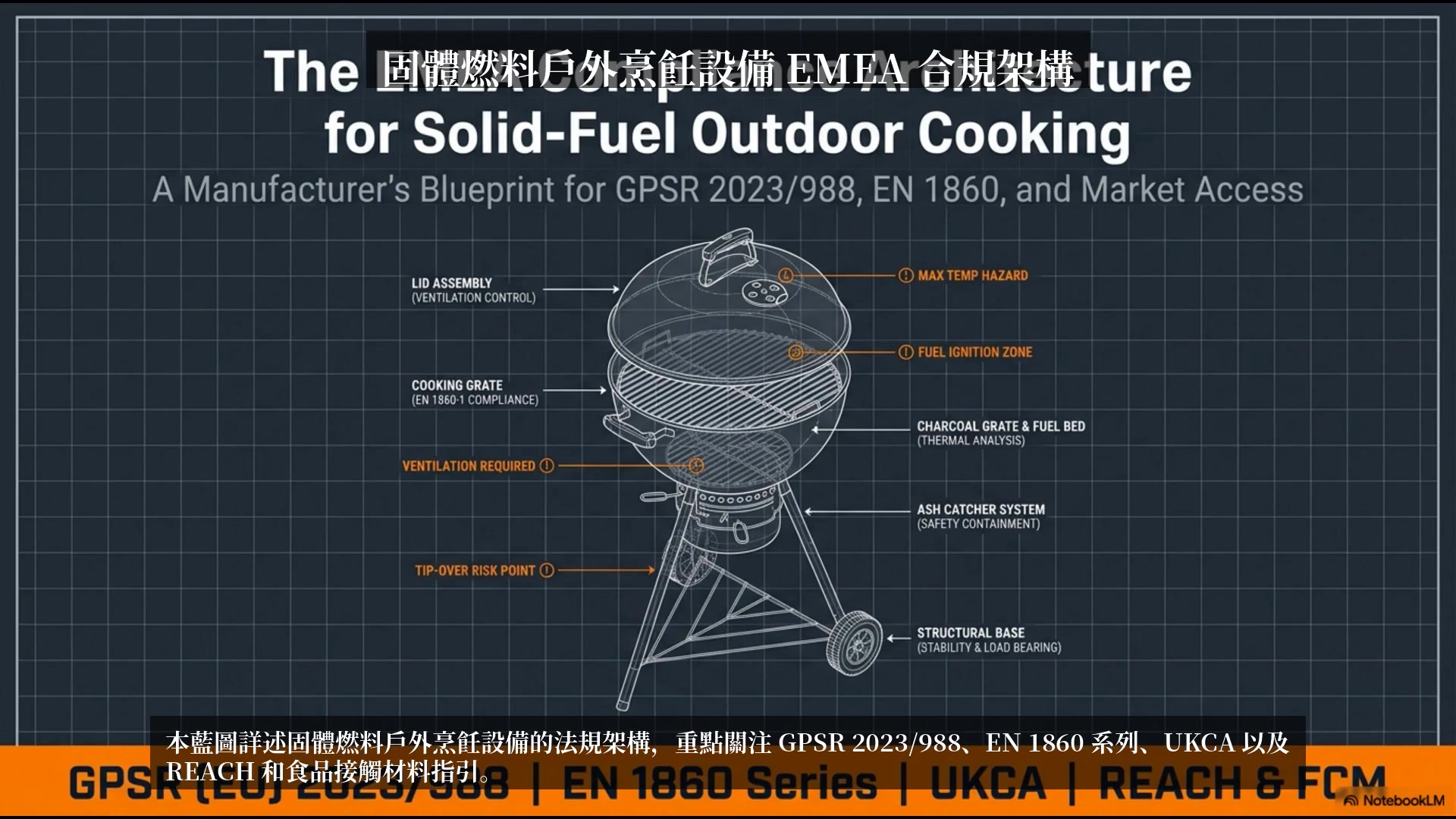
中文版 — EMEA 合規藍圖
🇬🇧 English Version
In the outdoor cooking appliance industry, there is no margin for error when it comes to product safety. Unlike electrical or gas-fired units — which fall under dedicated EU directives such as the Low Voltage Directive (LVD) or Gas Appliances Regulation (GAR) — charcoal-fired outdoor cooking equipment has historically operated without a dedicated EU regulation.
This changed on 13 December 2024, when the EU General Product Safety Regulation (GPSR, Regulation (EU) 2023/988) became fully applicable across all 27 member states, fundamentally reshaping how manufacturers, importers, and distributors must approach product safety for outdoor solid-fuel cooking units.
This article provides a practical compliance roadmap for manufacturers and quality professionals seeking to place charcoal-fired outdoor cooking appliances on EMEA (Europe, Middle East, and Africa) markets.
The Regulatory Landscape: Why GPSR Changes Everything
What Is GPSR?
The General Product Safety Regulation (GPSR) replaces the former General Product Safety Directive (GPSD, 2001/95/EC). Unlike a directive — which requires transposition into national law — GPSR is a regulation, meaning it applies directly and uniformly across every EU member state.
For outdoor charcoal cooking equipment, GPSR is the primary legal framework because no dedicated product-specific EU regulation exists for this category. The GPSR acts as a safety net, covering all non-food consumer products that lack harmonised legislation.
Scope of Products Covered
The following categories of outdoor solid-fuel cooking equipment fall under GPSR requirements:
| Product Category | Description |
|---|---|
| Ceramic Kamado Units | Egg-shaped ceramic cookers with charcoal fuel |
| Disposable Charcoal Cooking Units | Single-use portable cooking devices |
| Fire Pits with Cooking Accessories | Dual-purpose fire pits equipped with cooking grates |
| Hibachi-Style Portable Units | Compact Japanese-style charcoal cookers |
| Dome and Barrel-Type Units | Classic kettle and offset smoker designs |
| Smokers and Side-Firebox Units | Dedicated smoking appliances with solid-fuel chambers |
| Protective Covers | Waterproof covers for outdoor cooking units (subject to REACH/PFAS regulations) |
The EN 1860 Standard Series: Technical Requirements
While GPSR provides the legal framework, the EN 1860 series of European standards provides the technical specification for solid-fuel outdoor cooking equipment. Compliance with these harmonised standards gives a presumption of conformity with GPSR safety requirements.
EN 1860 Series Structure
| Standard | Title | Focus Area |
|---|---|---|
| EN 1860-1:2024 | Barbecues burning solid fuels — Requirements and test methods | Design, construction, stability, markings, instructions |
| EN 1860-2 | Barbecue charcoal and charcoal briquettes | Fuel quality specifications |
| EN 1860-3 | Ignition of barbecues | Firelighter and ignition method safety |
| EN 1860-4 | Single-use charcoal cooking units | Disposable product requirements |
The EN 1860-1:2024 revision (published February 2025) is the most critical standard for reusable outdoor cooking equipment. It specifies requirements for:
Mechanical Stability Testing: The unit must demonstrate sufficient mechanical strength and structural integrity under normal use conditions, including tip-over resistance, component retention, and load-bearing capacity.
Combustion Material Containment: The design must prevent ash, embers, and unburned fuel from escaping the combustion chamber, including adequate ash collection systems and secure fuel grate construction.
Thermal Safety Requirements: Surface temperatures and heat transfer characteristics must comply with safety limits — handles must remain below specified temperature thresholds, and structural integrity must be maintained throughout the full operating temperature range.
GPSR Article 9: Risk Analysis Requirements
Under GPSR Article 9, manufacturers must conduct and document an internal risk analysis before placing any product on the market. This analysis must address the following hazard categories:
Comprehensive Risk Matrix
| Hazard Category | Specific Risks | Mitigation Examples |
|---|---|---|
| Mechanical | Sharp edges, tipping risk, component detachment | Deburring, weighted bases, secure fastening |
| Thermal | Burn injuries, fire propagation, overheating | Insulated handles, heat shields, temperature warnings |
| Chemical | Coating leaching, paint emissions, enamel composition, PFAS in waterproof covers | REACH-compliant coatings, PFAS-free alternatives |
| Fire/Explosion | Improper fuel handling, incorrect fuel type, proximity to flammable materials | Clear fuel warnings, ignition procedure guidance |
| Environmental | Corrosion from outdoor exposure, weather degradation | Weather-resistant materials, protective coatings |
| Consumer | Incorrect assembly, child access, unattended operation | Assembly instructions, child-safety warnings, operational guidance |
PFAS in Outdoor Cooking Appliance Covers: A Growing Regulatory Concern
What Are PFAS?
PFAS (Per- and Polyfluoroalkyl Substances) are a group of over 10,000 synthetic chemicals widely used in consumer products for their water-resistant, grease-resistant, and stain-resistant properties. In the outdoor cooking appliance industry, PFAS are commonly found in:
- Protective covers: Waterproof and weather-resistant fabric coatings
- Textile treatments: Durable water repellent (DWR) finishes on cover materials
- Waterproofing sprays: Aftermarket treatments for outdoor equipment covers
These chemicals are often referred to as “forever chemicals” because they do not break down naturally in the environment and can accumulate in the human body over time, contributing to elevated cholesterol levels, suppressed immune responses, and thyroid disease.
Current EU Regulatory Framework for PFAS
| Regulation | Status | Impact on Appliance Covers |
|---|---|---|
| REACH Annex XVII | Existing restrictions on specific PFAS (PFHxS, PFOS, PFOA) | Covers containing these substances above threshold limits cannot be placed on EU market |
| SVHC Candidate List | Multiple PFAS listed as Substances of Very High Concern | Articles containing >0.1% w/w SVHC require SCIP notification and consumer communication |
| POP Regulation (EU) 2019/1021 | Bans specific PFAS (PFOS, PFOA, PFHxS) | Covers with banned PFAS are prohibited from EU market |
| ECHA PFAS Restriction Proposal (2025) | Updated August 2025, covers >10,000 PFAS substances; final opinion expected 2026 | Will potentially ban most PFAS in consumer textile coatings, including outdoor equipment covers |
| PFHxS Restriction (Regulation EU 2025/910) | Effective 10 October 2026 | Textiles, waterproof accessories, and consumer waterproofing sprays restricted for general public sale |
Compliance Actions for Manufacturers
Supply Chain Audit: Require all cover suppliers to provide material declarations confirming PFAS-free status or specifying PFAS types and concentrations used in waterproof coatings.
Testing Protocol: Implement PFAS screening (total fluorine analysis or targeted LC-MS/MS testing) for cover materials, especially for products sold through EU online marketplaces.
Alternative Materials: Explore PFAS-free waterproofing alternatives such as:
- Silicone-based water repellents (DWR)
- Fluorocarbon-free polyurethane (PU) coatings
- Wax-based water-repellent treatments
- Engineered fabrics with inherent water resistance (no chemical coating required)
SCIP Database Notification: If any cover component contains an SVHC-listed PFAS above 0.1% w/w, submit a SCIP notification to ECHA within 45 days of supply.
Consumer Communication: Under REACH Article 33, provide safety information to consumers within 45 days of request regarding any SVHC substances present in covers.
GPSR Risk Analysis Integration: Include PFAS-related chemical hazards in the GPSR Article 9 risk analysis for the complete product system (appliance + cover).
Technical File: What Must Be Included
Under GPSR, the technical file must be retained for 10 years and be available to market surveillance authorities upon request. Required contents include:
| Document Type | Description |
|---|---|
| Product Description | General description of the outdoor cooking appliance, including intended use and design specifications |
| Risk Analysis Report | Documented analysis covering all hazard categories per Article 9, including PFAS chemical risk assessment for covers |
| Test Reports | Results from EN 1860 series testing or equivalent safety assessments |
| Standards Reference List | Complete list of applicable European standards, with notation of partial applications |
| Material Declarations | Information on coatings, finishes, and food-contact surfaces, including cover material composition and PFAS status |
| Instruction Manuals | All language versions of assembly, operation, and safety instructions |
Labelling and Traceability: GPSR Articles 9, 16, and 21
GPSR introduces significantly enhanced labelling requirements compared to the previous directive. Every outdoor cooking appliance must carry the following information:
Required Labelling Elements
| Information | Where to Display | Notes |
|---|---|---|
| Product Identification | On the product body (preferred), or packaging | Model number, batch number, or serial number |
| Manufacturer Name | Product, packaging, or accompanying documents | Registered company name or trademark |
| Manufacturer Address | Product, packaging, or accompanying documents | Complete postal address — country name alone is insufficient |
| Electronic Contact | Product, packaging, or accompanying documents | Email address required — a static website URL is not sufficient |
| EU Responsible Person | Product, packaging, package, or accompanying documents | Name, full postal address, and electronic contact of the EU-based representative |
Language Requirements
Safety instructions and warnings must be provided in the official language(s) of the target member state. For example:
- Germany: Instructions must be available in German
- France: Instructions must be available in French
- Spain: Instructions must be available in Spanish
QR Code and Digital Labelling
GPSR Article 21 permits QR codes as a supplementary information channel — but they cannot replace the physical labelling requirements.
Cross-Regulatory Compliance: Beyond GPSR
Outdoor charcoal cooking appliances often intersect with multiple EU regulatory frameworks:
1. REACH Regulation (EC 1907/2006)
All metal and ceramic components with coatings, paints, or enamel finishes must comply with REACH chemical restrictions. Key considerations:
- SVHC (Substances of Very High Concern): Coatings must not contain SVHCs above 0.1% w/w threshold
- Restriction Annex XVII: Specific chemicals are banned or restricted in consumer products
- PFAS in Covers: Waterproof protective covers may contain PFAS — subject to current and upcoming restrictions (see PFAS section above)
2. Food Contact Materials Regulation (EC 1935/2004)
Any cooking surface that comes into contact with food during preparation must comply with food contact material regulations, including migration testing and Declaration of Compliance (DoC).
3. Packaging and Packaging Waste Regulation (PPWR)
Product packaging must comply with extended producer responsibility (EPR) requirements, including recyclability and heavy metal restrictions.
UK Market Access: UKCA and General Product Safety Requirements
Since 1 January 2025, UKCA marking has become mandatory for products placed on the Great Britain market. Key requirements include:
| Requirement | Detail |
|---|---|
| UKCA Marking | Required for Great Britain market (England, Scotland, Wales) |
| UK Responsible Person | Non-UK manufacturers must designate a UK-based responsible person |
| General Product Safety Regulations 2005 | UK equivalent of GPSR, with similar risk analysis and labelling requirements |
| BS EN 1860 Series | UK adopts identical standards (prefixed as BS EN) |
Online Marketplace Requirements
When selling through online marketplaces (Amazon, eBay, and similar platforms), GPSR imposes additional obligations:
| Information | Must Appear in Listing |
|---|---|
| Manufacturer Name and Contact Details | Yes — full postal address and electronic contact |
| EU Responsible Person Details | Yes — if manufacturer is located outside the EU |
| Product Identification | Yes — including product images showing identification marks |
| Safety Warnings | Yes — all applicable warnings and safety information |
Practical Compliance Checklist for Manufacturers
Pre-Market Phase
- Conduct documented risk analysis per GPSR Article 9
- Perform EN 1860-1:2024 testing (mechanical stability, thermal safety, combustion containment)
- Verify REACH compliance for all coatings and finishes
- Screen cover materials for PFAS content and document results
- Confirm food contact material compliance for cooking surfaces
- Compile technical file (10-year retention requirement)
- Designate EU Responsible Person (if manufacturing outside EU)
- Designate UK Responsible Person (if manufacturing outside UK)
Product Labelling Phase
- Apply product identification to product body
- Include manufacturer name and full postal address
- Provide electronic contact (email address)
- Include EU and UK Responsible Person details
- Prepare instruction manuals in all target market languages
Supply Chain Phase
- Establish product traceability system
- Obtain PFAS-free declarations from cover material suppliers
- Register with Safety Business Gateway for incident reporting
- Set up consumer complaint registry
- Maintain supply chain records
Conclusion
The EMEA market for outdoor charcoal cooking appliances offers significant commercial opportunity, but it demands rigorous attention to product safety compliance. GPSR Regulation 2023/988, combined with EN 1860 series standards, REACH chemical restrictions (including PFAS), and parallel UK requirements, creates a comprehensive but manageable compliance framework.
Manufacturers who invest in systematic risk analysis, thorough technical documentation, and proactive supply chain quality management will find compliance not as a barrier, but as a competitive advantage.
What compliance challenges has your organisation faced when entering new regional markets?
🇨🇳 中文版
在戶外烹飪設備行業,產品安全方面不容許任何差錯。與受歐盟低電壓指令(LVD)或燃氣設備法規(GAR)等專門指令管轄的電氣或燃氣設備不同——燃木炭戶外烹飪設備在歷史上一直缺乏專屬的歐盟法規。
這一局面在 2024年12月13日 發生了根本性改變,歐盟通用產品安全法規(GPSR,法規 (EU) 2023/988)在所有27個成員國全面適用,徹底重塑了製造商、進口商和分銷商對戶外固體燃料烹飪設備產品安全的管理方式。
本文為尋求在 EMEA(歐洲、中東和非洲)市場銷售燃木炭戶外烹飪設備的製造商和品質專業人士提供實用的合規路線圖。
法規框架總覽:為何 GPSR 改變了一切
什麼是 GPSR?
通用產品安全法規(GPSR)取代了先前的通用產品安全指令(GPSD,2001/95/EC)。與需要轉化為國內法的指令不同,GPSR 是一項法規,這意味著它直接且統一地適用於每一個歐盟成員國。
對於燃木炭戶外烹飪設備,GPSR 是主要法律框架,因為該類別沒有專門的產品特定歐盟法規。GPSR 作為安全網,覆蓋所有缺乏協調立法的非食品消費品。
適用的產品範圍
以下類別的戶外固體燃料烹飪設備受 GPSR 要求管轄:
| 產品類別 | 說明 |
|---|---|
| 陶瓷 Kamado 設備 | 蛋形陶瓷木炭烹飪器 |
| 一次性木炭烹飪設備 | 單次使用的便攜式烹飪裝置 |
| 帶烹飪配件的火坑 | 配備烹飪烤架的多用途火坑 |
| 日式便攜式設備 | 緊湊型日式木炭烹飪器 |
| 圓頂型和桶型設備 | 經典水壺型和偏移煙燻器設計 |
| 煙燻器和側火箱設備 | 帶固體燃料室的專用煙燻設備 |
| 防護罩 | 戶外烹飪設備的防水罩(受 REACH/PFAS 法規管轄) |
EN 1860 標準系列:技術要求
雖然 GPSR 提供了法律框架,但 EN 1860 系列歐洲標準為固體燃料戶外烹飪設備提供了技術規範。符合這些協調標準可獲得 GPSR 安全要求的符合性推定。
EN 1860 系列結構
| 標準 | 名稱 | 重點領域 |
|---|---|---|
| EN 1860-1:2024 | 燃燒固體燃料的燒烤設備——要求和測試方法 | 設計、結構、穩定性、標記、說明 |
| EN 1860-2 | 燒烤木炭和木炭塊 | 燃料質量規格 |
| EN 1860-3 | 燒烤點火 | 引火劑和點火方法安全性 |
| EN 1860-4 | 一次性木炭烹飪設備 | 一次性產品要求 |
EN 1860-1:2024 修訂版(2025年2月發布)是可重複使用戶外烹飪設備最關鍵的標準,它規定了以下要求:
機械穩定性測試:設備必須在正常使用條件下展示足夠的機械強度和結構完整性,包括抗傾倒性、部件固定和承重能力。
燃燒材料密封:設計必須防止灰燼、餘燼和未燃燒的燃料從燃燒室逸出,包括適當的灰燼收集系統和安全的燃料架結構。
熱安全要求:表面溫度和熱傳遞特性必須符合安全限值——手柄必須保持在規定溫度閾值以下,結構完整性必須在整個操作溫度範圍內保持。
GPSR 第9條:風險分析要求
根據 GPSR 第9條,製造商在將任何產品投放市場之前必須進行並記錄內部風險分析。該分析必須涵蓋以下危害類別:
綜合風險矩陣
| 危害類別 | 具體風險 | 緩解措施示例 |
|---|---|---|
| 機械 | 鋒利邊緣、傾倒風險、部件脫落 | 去毛刺、加重底座、安全緊固 |
| 熱 | 燙傷、火災蔓延、過熱 | 隔熱手柄、熱防護罩、溫度警告 |
| 化學 | 塗層滲出、油漆排放、琺瑯成分、防護罩中的 PFAS | REACH 合規塗層、無 PFAS 替代品 |
| 火災/爆炸 | 燃料處理不當、燃料類型錯誤、靠近易燃材料 | 明確燃料警告、點火程序指導 |
| 環境 | 戶外暴露腐蝕、天氣降解 | 耐候材料、保護塗層 |
| 消費者 | 錯誤組裝、兒童接觸、無人看管操作 | 組裝說明、兒童安全警告、操作指南 |
戶外烹飪設備防護罩中的 PFAS:日益增長的監管關注
什麼是 PFAS?
PFAS(全氟和多氟烷基物質) 是一組超過 10,000 種合成化學物質,因其防水、防油和防污特性而廣泛用於消費品中。在戶外烹飪設備行業,PFAS 通常存在於:
- 防護罩:防水和耐候織物塗層
- 紡織品處理:防護罩材料上的持久防水(DWR)塗層
- 防水噴霧劑:戶外設備罩的售後處理劑
這些化學物質常被稱為**「永久性化學物質」**,因為它們不會在自然界中分解,並且可以在人體內積累,導致膽固醇水平升高、免疫反應抑制和甲狀腺疾病。
當前歐盟 PFAS 監管框架
| 法規 | 狀態 | 對設備防護罩的影響 |
|---|---|---|
| REACH 附件 XVII | 現有對特定 PFAS(PFHxS、PFOS、PFOA)的限制 | 含有這些物質超過閾值的防護罩不得投放歐盟市場 |
| SVHC 候選清單 | 多種 PFAS 被列為高度關注物質 | 含有 >0.1% w/w SVHC 的產品需要 SCIP 通知和消費者溝通 |
| POP 法規 (EU) 2019/1021 | 禁止特定 PFAS(PFOS、PFOA、PFHxS) | 含有被禁 PFAS 的防護罩被禁止進入歐盟市場 |
| ECHA PFAS 限制提案(2025年) | 2025年8月更新,涵蓋超過 10,000 種 PFAS 物質;最終意見預計 2026年 | 可能禁止消費品紡織塗層中的大部分 PFAS,包括戶外設備防護罩 |
| PFHxS 限制(法規 EU 2025/910) | 2026年10月10日生效 | 紡織品、防水配件和消費者防水噴霧劑限制向公眾銷售 |
製造商的合規行動
供應鏈審計:要求所有防護罩供應商提供材料聲明,確認無 PFAS 狀態或說明防水塗層中使用的 PFAS 類型和濃度。
測試方案:對防護罩材料實施 PFAS 篩查(總氟分析或靶向 LC-MS/MS 測試),特別是通過歐盟在線市場銷售的產品。
替代材料:探索無 PFAS 的防水替代方案,例如:
- 矽基防水劑(DWR)
- 無氟碳聚氨酯(PU)塗層
- 蠟基防水處理
- 具有固有防水性能的工程織物(無需化學塗層)
SCIP 數據庫通知:如果任何防護罩組件含有超過 0.1% w/w 的 SVHC 清單 PFAS,必須在供應後 45 天內向 ECHA 提交 SCIP 通知。
消費者溝通:根據 REACH 第33條,在消費者請求後 45 天內提供防護罩中任何 SVHC 物質的安全信息。
GPSR 風險分析整合:將 PFAS 相關的化學危害納入完整產品系統(設備 + 防護罩)的 GPSR 第9條風險分析中。
技術文件:必須包含的內容
根據 GPSR,技術文件必須保留 10年,並在市場監管機構要求時提供。必須包含的內容包括:
| 文件類型 | 說明 |
|---|---|
| 產品描述 | 戶外烹飪設備的一般描述,包括預期用途和設計規格 |
| 風險分析報告 | 涵蓋第9條所有危害類別的記錄分析,包括防護罩的 PFAS 化學風險評估 |
| 測試報告 | EN 1860 系列測試或同等安全評估的結果 |
| 標準參考清單 | 適用歐洲標準的完整清單,標註部分適用的標準 |
| 材料聲明 | 塗層、飾面和食品接觸表面的信息,包括防護罩材料成分和 PFAS 狀態 |
| 說明書 | 所有語言版本的組裝、操作和安全說明 |
標示和追溯要求:GPSR 第9、16和21條
GPSR 引入了比先前指令顯著增強的標示要求。每台戶外烹飪設備必須攜帶以下信息:
必須標示的元素
| 信息 | 標示位置 | 說明 |
|---|---|---|
| 產品識別碼 | 產品本體(優先)或包裝 | 型號、批次號或序列號 |
| 製造商名稱 | 產品、包裝或隨附文件 | 註冊公司名稱或商標 |
| 製造商地址 | 產品、包裝或隨附文件 | 完整郵寄地址——僅國家名稱不足 |
| 電子聯繫方式 | 產品、包裝或隨附文件 | 需要電子郵件地址——靜態網站 URL 不足 |
| 歐盟負責人信息 | 產品、包裝、包裹或隨附文件 | 歐盟代表的姓名、完整郵寄地址和電子聯繫方式 |
語言要求
安全說明和警告必須以目標成員國的官方語言提供。例如:
- 德國:說明必須提供德語版本
- 法國:說明必須提供法語版本
- 西班牙:說明必須提供西班牙語版本
QR 碼和數位標示
GPSR 第21條允許 QR 碼作為補充信息渠道——但它們不能替代實體標示要求。
交叉法規合規:超越 GPSR
燃木炭戶外烹飪設備通常涉及多個歐盟法規框架:
1. REACH 法規 (EC 1907/2006)
所有帶有塗層、油漆或琺瑯飾面的金屬和陶瓷部件必須符合 REACH 化學限制。關鍵考量:
- SVHC(高度關注物質):塗層不得含有超過 0.1% w/w 閾值的 SVHC
- 限制附件 XVII:特定化學物質在消費品中被禁止或限制
- 防護罩中的 PFAS:防水防護罩可能含有 PFAS——受當前和即將實施的限制(見上文 PFAS 章節)
2. 食品接觸材料法規 (EC 1935/2004)
任何在烹飪過程中與食物接觸的烹飪表面必須符合食品接觸材料法規,包括遷移測試和符合性聲明(DoC)。
3. 包裝和包裝廢棄物法規(PPWR)
產品包裝必須符合延伸生產者責任(EPR)要求,包括可回收性和重金屬限制。
英國市場准入:UKCA 和通用產品安全要求
自 2025年1月1日 起,UKCA 標記已成為投放英國大不列顛市場產品的強制性要求。關鍵要求包括:
| 要求 | 詳情 |
|---|---|
| UKCA 標記 | 英國大不列顛市場(英格蘭、蘇格蘭、威爾士)必需 |
| 英國負責人 | 非英國製造商必須指定英國負責人 |
| 通用產品安全法規 2005 | 英國 GPSR 對應法規,具有類似的風險分析和標示要求 |
| BS EN 1860 系列 | 英國採用相同標準(前綴為 BS EN) |
在線市場要求
通過在線市場(Amazon、eBay 等類似平台)銷售時,GPSR 對產品列表施加了額外義務:
| 信息 | 必須在列表中顯示 |
|---|---|
| 製造商名稱和聯繫詳情 | 是——完整郵寄地址和電子聯繫方式 |
| 歐盟負責人詳情 | 是——如果製造商位於歐盟境外 |
| 產品識別碼 | 是——包括顯示識別標記的產品圖片 |
| 安全警告 | 是——所有適用的警告和安全信息 |
製造商實用合規檢查清單
上市前階段
- 按照 GPSR 第9條進行記錄的風險分析
- 執行 EN 1860-1:2024 測試(機械穩定性、熱安全、燃燒密封)
- 驗證所有塗層和飾面的 REACH 合規性
- 篩查防護罩材料的 PFAS 含量並記錄結果
- 確認烹飪表面的食品接觸材料合規性
- 編制技術文件(10年保留要求)
- 指定歐盟負責人(如在歐盟境外製造)
- 指定英國負責人(如在英國境外製造)
產品標示階段
- 在產品本體上應用產品識別碼
- 包含製造商名稱和完整郵寄地址
- 提供電子聯繫方式(電子郵件地址)
- 包含歐盟和英國負責人詳情
- 準備所有目標市場語言的說明書
供應鏈階段
- 建立產品追溯系統
- 從防護罩材料供應商獲取無 PFAS 聲明
- 在 Safety Business Gateway 註冊以進行事故報告
- 建立消費者投訴登記冊
- 保持供應鏈記錄
結論
戶外燃木炭烹飪設備的 EMEA 市場提供了巨大的商業機會,但也要求對產品安全合規進行嚴格關注。GPSR 法規 2023/988 結合 EN 1860 系列標準、REACH 化學限制(包括 PFAS)以及平行的英國要求,創建了一個全面但可管理的合規框架。
投資於系統風險分析、全面技術文件和主動供應鏈品質管理的製造商將發現合規不是障礙,而是競爭優勢。
您的組織在進入新區域市場時面臨哪些合規挑戰?