🇺🇸 English Version
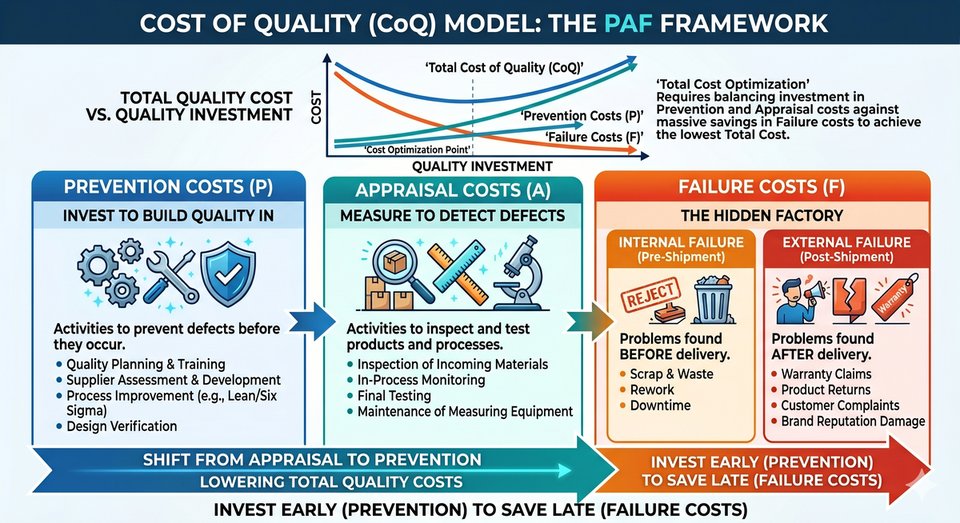
In the intersection of quality management and supply chain operations, there lies a subject that has gained significant attention in recent years—one with immense practical value yet often overlooked: the Cost of Quality (CoQ) PAF Framework (Prevention, Appraisal, Failure).
This classic perspective helps managers connect “quality” directly with “financial performance.”
🇨🇳 中文版
在品質管理與供應鏈的交織地帶,有一個近年來備受重視、極具實務價值卻常被忽視的主題:品質成本模型:PAF 曲線(Prevention, Appraisal, Failure)。
這是一個能幫助管理者將「品質」與「財務效益」掛鉤的經典視角。
The Core Philosophy / 核心哲學
🇺🇸 Quality Is Not Free, But “No Quality” Is More Expensive
Many people mistakenly believe that high quality means high cost. However, management guru Philip Crosby proposed a revolutionary idea: “Quality is Free.” What is truly expensive is the cost incurred from “doing things wrong.”
Managers break these costs into three major categories (the PAF model):
Prevention Costs (P): Costs invested to prevent problems from occurring.
- Supplier audits and qualification
- Education and training programs
- Process planning and design controls
- Quality management system implementation
- Preventive maintenance
Key insight: Every dollar invested here saves exponentially more downstream.
Appraisal Costs (A): Costs invested to detect problems that have already occurred.
- Incoming inspection and testing
- In-process inspection
- Final product verification
- Laboratory equipment calibration
- Supplier surveillance audits
Key insight: Appraisal only “finds” problems—it does not “eliminate” them.
Failure Costs (F): Costs resulting from defects that escaped prevention and appraisal.
Internal Failure (before shipment):
- Scrap and material waste
- Rework and repair costs
- Retesting after rework
- Production line downtime
External Failure (after shipment):
- Customer returns and warranty claims
- Field service and repair costs
- Product recall expenses
- Legal liability and litigation
- Brand reputation damage
Key insight: External failure costs are often 10-100x higher than internal failure costs.
🇨🇳 品質不是免費的,但「沒品質」更貴
許多人誤以為高品質代表昂貴。但管理大師 菲利浦·克勞斯比(Philip Crosby) 提出:「品質是免費的」(Quality is Free)。真正昂貴的是那些因為「做得不對」而產生的成本。
管理者將這些成本拆解為三大類(即 PAF 模型):
預防成本(Prevention): 為了不讓問題發生而投入的成本。
- 供應商審核與資格認證
- 教育訓練計畫
- 製程規劃與設計管制
- 品質管理系統建置
- 預防性維護
關鍵洞察: 在這裡投入的每一塊錢,能在下游省下數倍的支出。
鑑定成本(Appraisal): 為了找出已發生的問題而投入的成本。
- 進料檢驗與測試
- 製程中檢驗
- 成品驗證
- 實驗室儀器校準
- 供應商監督審核
關鍵洞察: 鑑定只能「發現」問題——它不能「消除」問題。
失敗成本(Failure): 因為缺陷逃過了預防與鑑定而產生的成本。
內部失敗(出貨前):
- 廢料與物料浪費
- 重工與修復成本
- 重工後的重新測試
- 生產線停機時間
外部失敗(出貨後):
- 客戶退貨與保固索賠
- 現場服務與維修成本
- 產品召回費用
- 法律責任與訴訟
- 品牌商誉受損
關鍵洞察: 外部失敗成本通常是內部失敗成本的 10-100倍。
The Leverage Effect / 槓桿效應
🇺🇸 Every USD 1 Invested in Prevention Saves:
| Category | Savings Ratio |
|---|---|
| Appraisal | USD 10 |
| Failure | USD 100 |
This is the fundamental ROI equation that shifts management focus from reactive to proactive.
🇨🇳 在預防上投入的每 1 元,通常能省下:
| 類別 | 節省比率 |
|---|---|
| 鑑定成本 | 10 元 |
| 失敗成本 | 100 元 |
這是將管理重心從「反應式」轉向「主動式」的基本 ROI 公式。
Application in Supply Chain / 供應鏈中的實踐
🇺🇸 From “Police” to “Coach”
Applying this model to supply chain transforms the manager role:
| Traditional Approach | Modern Quality Approach |
|---|---|
| Audit to find faults | Audit to identify improvement opportunities |
| Reject non-conforming parts | Help suppliers prevent non-conformance |
| Focus on incoming inspection | Focus on upstream process capability |
| Penalize defects | Reward quality improvement milestones |
| Transactional relationship | Partnership and capability building |
Practical Supplier Development Activities:
- Process Capability Studies (Cpk analysis)
- Quality System Implementation Support
- Technical Training Programs
- Joint Root Cause Analysis
- Continuous Improvement Projects
The shift: From reactive “firefighting” to proactive “fire prevention.”
🇨🇳 從「警察」到「教練」
將此模型應用於供應鏈,管理者的角色會轉變:
| 傳統做法 | 現代品質做法 |
|---|---|
| 審核找缺點 | 審核找出改善機會 |
| 拒收不合格品 | 協助供應商預防不合格 |
| 著眼於進料檢驗 | 著眼於上游製程能力 |
| 處罰缺陷 | 獎勵品質改善里程碑 |
| 交易型關係 | 合作夥伴與能力建設 |
實務供應商開發活動:
- 製程能力研究(Cpk 分析)
- 品質系統建置支援
- 技術培訓計畫
- 聯合根本原因分析
- 持續改善專案
轉變: 從反應式的「救火」到主動式的「防火」。
Three-Minute Summary / 三分鐘速成精華
🇺🇸 Key Takeaways
| Principle | Key Takeaway |
|---|---|
| Management Goal | Reduce Total Quality Cost, not just purchase price |
| Quality Perspective | Appraisal discovers problems; Prevention eliminates them |
| Core Mindset | Invest more in R&D and training rather than regretting after complaints |
| Financial Logic | Prevention USD 1 saves Appraisal USD 10 and Failure USD 100 |
| Role Evolution | From “Police” to “Coach” |
🇨🇳 關鍵要點
| 原則 | 關鍵要點 |
|---|---|
| 管理目標 | 降低總品質成本,而非單純壓低採購價格 |
| 品質觀點 | 鑑定只能「發現」問題,唯有預防能「消除」問題 |
| 核心思維 | 把錢花在刀口上——寧可在研發與培訓時多花一點,也不要在客戶投訴時追悔莫及 |
| 財務邏輯 | 預防 1 元省下鑑定 10 元與失敗 100 元 |
| 角色演進 | 從「警察」到「教練」 |
The Path Forward / 前行之路
🇺🇸 For Quality Leaders
- Map your current PAF cost distribution
- Calculate your leverage ratios
- Identify prevention investment gaps
- Shift budget allocation from Appraisal to Prevention
- Measure Total Quality Cost trends
- Develop supplier capability programs
🇨🇳 品質領導者的行動指南
- 描繪目前的 PAF 成本分布
- 計算槓桿比率
- 識別預防投資缺口
- 調整預算分配(從鑑定轉向預防)
- 衡量總品質成本趨勢
- 發展供應商能力計畫
How do you balance prevention investment against inspection costs in your supply chain? 您如何在供應鏈中平衡預防投資與檢驗成本?